Overview
The Nightingale lab and the Duke Ultrasound group seek to investigate the benefits and challenges associated with elevated acoustic output in ARFI-based techniques, motivating the development of output limits based upon patient safety rather than historical precedence.
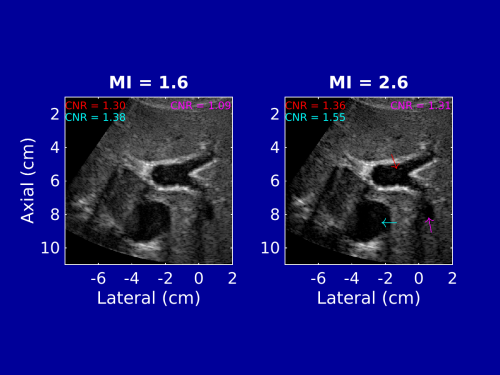
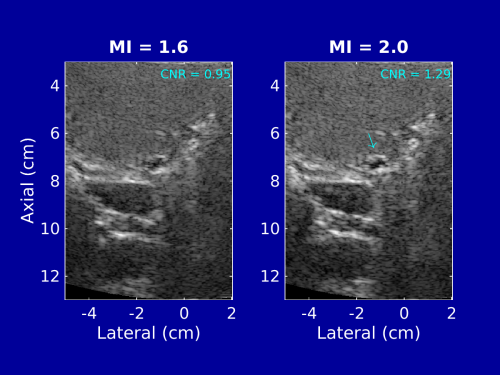
In collaboration with Drs. Clare Haystead in the Department of Radiology at DUMC, we investigated the benefit of using elevated acoustic output in hepatic harmonic imaging and in ultrasound shear wave harmonic tracking. We developed custom sequences to acquire real B-mode pulse-inversion harmonic images, as well as M-mode and shear wave sequences with low and high Mechanical Index (MI) values. We have completed clinical studies to evaluate the image quality improvement using elevated acoustic output with patients undergoing general abdominal ultrasound exams.
Related Publications
- Deng Y, Palmeri M, Haystead C, Nightingale K "Evaluating the Benefit of Elevated Acoustic Output in Harmonic Motion Esetimation in Ultrasonic Shear Wave Elasticity Imaging", UMB, 44(2): 303-310, 2018. PMCID: PMC5743577.
- Deng Y, Palmeri M, Rouze N, Haystead C., Nightingale K. "Quantifying Image Quality Improvement Using Elevated Acoustic Output in B-Mode Harmonic Imaging", UMB, 43(10): 2416-2425, 2017. PMCID: PMC5580090.
- Deng Y, Palmeri M, Rouze N, Nightingale K. “Quantifying the benefit of elevated acoustic output in harmonic imaging”. Proceedings of the 2015 IEEE Ultrasonics Symposium, Taipei, 2015.
- Deng Y, Palmeri M, Rouze N, Rosenzweig S, Abdelmalek M, Nightingale K.“Analyzing the impact of increasing Mechanical Index (MI) and energy deposition on shear wave speed (SWS) reconstruction in human liver”, Ultrasound in Medicine and Biology, 41(7): 1948-1957, 2015. http://www.ncbi.nlm.nih.gov/pmc/articles/PMC4461469/
Funding
This research was supported by NIH grants R01EB002132 and R01EB022106
Figures